
McCarthy水业务负责人:当代水项目聚焦“最后一滴水”
McCarthy Building Cos.新任水业务总裁Jaren Murphy在凤凰城接受专访,指出美国水项目市场过去五年经历“不可思议”增长,如今几乎所有大型市政机构都拥有十亿美元级资本改善计划。他分析西部受科罗拉多河干旱驱动聚焦水回用,东部和中西部则因老化基础设施和风暴应对需求增长。McCarthy水业务约占公司总建设量5%,公司偏好早期介入的协作交付模式。展望未来,他预测西南部先进水厂建设需求将持续10至20年,中西部老化基础设施升级刚刚开始,得州因产业资金涌入保持强劲势头。
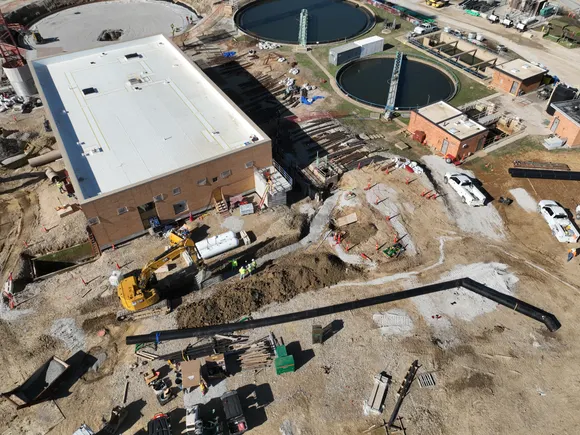
Water is life. Just ask Jaren Murphy.
Murphy is president of water at McCarthy Building Cos., based in Phoenix, wherethe effects of low Colorado River levelsare front-page news.
He took over the builder's water division this month, after serving as senior vice president and head of the water business since September 2024,according to his LinkedIn profile. Murphy is optimistic about the outlook for water projects, a view that may be supported by$30 billion in federal investment— $30.5 billion, to be exact.
Here, Murphy spoke with Construction Dive, a sister publication of ESG Dive, about how he sees the water market changing, what McCarthy looks for in water projects, and how projects vary by region.
Editor's note: This interview has been edited for length and clarity.
Construction Dive: How has the water project market changed over the past five years?
Jaren Murphy:The last five years have been an incredible journey.
Back in 2021, a $200 million to $250 million project was considered large nationwide. There was really only one that was at the billion-dollar level — theNortheast Water Purification Plant。
for the city of Houston. Today, almost every major municipality, water district, etc., has a capital improvement plan exceeding $1 billion and is working to upgrade infrastructure and build new plants. The overall growth in this market over the past five years has truly been remarkable.
There are many drivers of growth, and many of them are regional.
In the West, the main driver is the Colorado River and the drought we've experienced. There's a lot of work around advanced water treatment and water reuse — how to recycle water after municipal and industrial use, to squeeze every last drop in the Southwest.
In the East and Midwest, the drivers are aging infrastructure, hurricanes, and the ability to handle massive amounts of water during storm events.
Construction Dive: How has McCarthy's water business specifically changed over the past five years?

Right now, water makes up about 5% of McCarthy's total construction volume, and that percentage has been fairly consistent. As McCarthy has grown overall, the water business has grown right along with it.
That growth is driven by larger and larger projects across different sectors nationwide, like health care, mission-critical and data centers, solar, renewable energy, etc. Many of those projects are growing in size and dollar amount, so while the percentage hasn't changed, the absolute dollar value is higher.
Construction Dive: What does McCarthy prioritize when selecting water projects?
We look to achieve 100% collaborative delivery in our water projects.
We gravitate toward CM at-risk or design-build, especially progressive design-build, so we can get involved early in the project. That helps us understand where the project is going, what technology is being used, and of course the budget, and how we're going to find the skilled labor to build it. We like to be involved at the very early stages, working alongside the owner and the engineer.
A lot of our projects are essentially like changing the drain pipe under your sink while the water is running.
You can't shut down a water plant. It has to keep producing water, keep treating water. There's a lot of complexity in how you build it and how you integrate everything.
What looks feasible on a plan sheet or in a specification can be completely different when you're actually in the field with people, machinery, and equipment.
In a traditional hard-bid environment, it's hard to get together and solve those kinds of problems because the approach is often set without the people who are actually building it. So if we can get in early, we can drive that collaborative approach to success.
Construction Dive: What are your predictions for the next decade?
I don't think the Colorado River's impact on the Southwest is going away. We're going to feel that for a long time.
In the Southwest, the need to build advanced water plants and larger-scale solutions is going to drive the market for the next 10 to 15, maybe even 20 years.
I think the Midwest is just beginning its aging infrastructure upgrades. Most water plants were built in the '60s and '70s with a 50-year design life. So now, we're right at that point where we need to upgrade plants, update technology, and deal with aging infrastructure.
As for places like Texas, they continue to need different water sources and treatment methods. And because of the money coming in from those industries, I think we'll continue to see strong tailwinds.
I think this market is going to continue to break records in terms of the dollar amounts invested in water, because without water, none of the growth happens. Without water, communities can't develop, cities can't expand, and industries can't grow. So water is going to be at the forefront of all growth.