
Agriculture-Driven Future: How Farms Are Reshaping the Renewable Energy Transition in 2024
In 2024, farm renewable energy is expected to see significant growth. From agrivoltaics to anaerobic digesters and the expansion of biofuel markets, farmers are leveraging new technologies to reduce carbon emissions and generate income. Based on COP28 commitments, U.S. Energy Information Administration forecasts, and insights from industry experts, this article analyzes the latest developments and challenges in the farm energy transition.
Editor's note: This article is part of a series on trends impacting the agricultural industry in 2024.
The old adage "food is fuel" is becoming increasingly apt as agriculture plays a more significant role in the global transition to renewable energy. To reduce carbon emissions and industrial practices on farmland, more producers are seeking sustainable methods to maximize operational efficiency while opening up revenue opportunities.
At the recent UN climate summit COP28, several major food companies committed billions of dollars and outlined plans to cut methane emissions, move away from fossil fuel use, and support farmers in adjusting their operations and practices to achieve their sustainability goals. Driven by this, farm renewable energy is expected to see growth this year.
Despite critics questioning whether many solutions amount to "greenwashing," farmers are making a series of unprecedented changes on their farms. With new financial support, farms are using wind turbines or solar panels to generate electricity for their operations, converting cow manure into abundant biogas, or growing crops to be pressed into aviation biofuels. Here are key points to watch for farm renewable energy in 2024.
Agriculture off the grid
According to the U.S. Energy Information Administration, wind and solar are expected to grow by a combined 39% in 2024 as more capacity comes online, surpassing coal-fired electricity generation for the first time. But achieving this goal requires a significant amount of land.
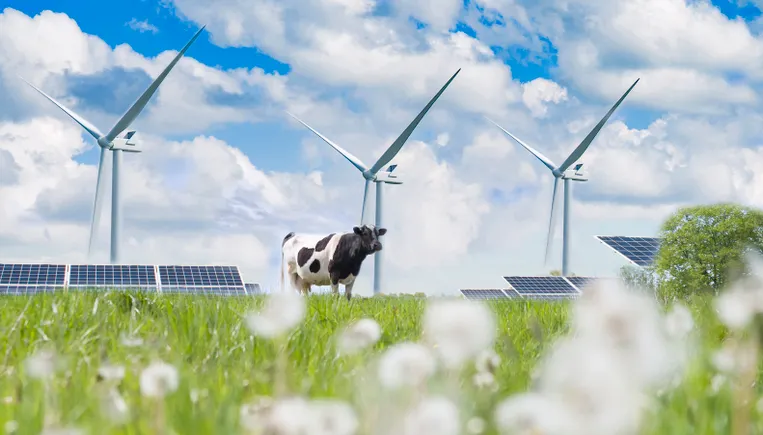
Agrivoltaics, which involves conducting agriculture and electricity generation on the same land simultaneously, is one solution. This practice not only helps farmers diversify their income but also reduces energy consumption in the face of climate change. The concept, proposed by two European researchers in 1981, involves growing crops and raising livestock under or between solar panels. In the United States, this remains a relatively new practice, with the most common applications including apiaries or sheep grazing, but farmers are also growing vegetables and raising chickens and rabbits.
"Innovation in this field is constant," said Stacie Peterson, energy program director at the National Center for Appropriate Technology, which focuses on farms and sustainable solutions. "We've seen more growth in the past year." The National Renewable Energy Laboratory has identified 477 agrivoltaic projects with a total solar capacity of nearly 7.2 gigawatts, with more than 150 new projects added in the past nine months.
These projects create new revenue streams for farmers. Farmers who install their own panels can reduce their own energy costs while selling excess electricity to utility companies or cooperatives. Additionally, farmers can lease their land to solar companies, reducing some upfront infrastructure costs. Beyond generating enough electricity to power nearby homes, solar panel infrastructure can also improve agricultural operations. The panels provide shade for crops and livestock, creating a cooling effect that reduces overall water usage. This is particularly useful for water-intensive crops in places like California and Oregon, Peterson said.
However, farmers must conduct extensive research to ensure agrivoltaics is suitable for their situation. Federal grants and loan opportunities make building renewable energy infrastructure more cost-effective, but this also depends on how farmers utilize their land, Peterson said. "In some cases, costs can be significantly higher," she said. For example, co-locating cattle requires more steel for additional fencing, while harvesting honey or raising sheep is less costly.
Other challenges may involve policy or grid issues. Utility infrastructure varies across the country, limiting how farmers can use the electricity they generate. Some agrivoltaic projects are too small to sell electricity directly to power companies, so they sell to cooperatives or third parties instead. Farmers can also store electricity for their own use later. Depending on the scale of operations, the site may be classified as agricultural or industrial land, resulting in significant tax implications. Although agrivoltaics aims to alleviate land-use conflicts, community support remains crucial for project initiation. "You have to consider its impact on the local community," she said, referring to changing the local cultural landscape.
Biodigesters
Cows are well-known for having a methane problem. According to the U.S. Environmental Protection Agency, livestock accounts for about 33% of the nation's methane emissions. Most of this comes from enteric fermentation (the process by which cows digest food), but a significant portion also stems from how animal manure is stored and managed. One way farmers are addressing this issue is through anaerobic digestion, which diverts methane emissions by converting manure into abundant biogas.
John Forcier, an expert in biogas and anaerobic digestion, believes this technology can not only improve the environment but also create potential revenue streams for small and medium-sized family farms in his home state of Vermont. The digester itself is a sealed container where bacteria break down organic matter, such as manure, to produce usable gas. Once captured, the biogas can power engines, turbines, or fuel cells to provide heat or electricity, according to the Institute for Energy and Environmental Research. It can also be further processed into biomethane, injected into natural gas pipelines, or used as vehicle fuel. On-site digesters also convert waste into a less odorous, nutrient-rich digestate that can be applied to farmland, reducing fertilizer needs by up to 50%.
"It's truly a win-win-win situation," Forcier said. These large machines, similar to pressure cookers, have been growing in popularity among farmers for years. According to the latest USDA data, the number of on-farm anaerobic digesters peaked at 322 in 2021. Meanwhile, oil giants like Shell and Chevron are exploring the potential of biogas, and companies dedicated to helping farmers convert food and farm waste have also emerged.
Despite rising adoption rates, there are barriers to entry. According to the U.S. Environmental Protection Agency, startup costs are high and may exceed the benefits of operating a digester, including additional staff and permitting requirements. Revenue from renewable electricity is often too low to offset the deficit. In recent years, environmental advocates have also opposed anaerobic digesters, arguing that these machines actually undermine efforts to combat climate change. According to a letter signed by 200 environmental groups, biogas facilities have been found to have leaks and sludge spills, exacerbating air and water pollution. Forcier acknowledged that biodigesters can cause environmental problems when farmers "fail to maintain them properly." "But with the right technology, the right feedstock, the right recipe, and the right assistance, it's actually simple," Forcier said.
New markets for biofuels
Although the ethanol market faced headwinds in 2023 due to the expansion of electric vehicles, new opportunities for corn- or soybean-based fuels may be on the horizon. The U.S. Environmental Protection Agency disappointed advocates last year by stepping back on potential biofuel targets. Ethanol, once seen as a sustainable fuel for passenger vehicles, is now taking a backseat as the electric vehicle industry rapidly grows. Instead, farmers are finding increased demand in the renewable diesel industry, which is used to power heavy industries that are difficult to electrify. For example, all-electric airplanes and cargo ships are not yet practical, making biofuels an important solution.
Over the past year or so, a significant amount of new renewable diesel capacity (typically made from soybeans) has come online, with more construction underway in the Midwest. Meanwhile, more agricultural companies are partnering with oil giants to find sustainable solutions for aviation and marine fuels. Scott Richman, chief economist at the Renewable Fuels Association, said ethanol production may see a slight increase over last year, while renewable diesel will achieve significant growth. He also expects sustainable aviation fuel to take off. "They have enormous potential," Richman said of the emerging biofuel categories.
The Biden administration recently announced new opportunities for agricultural producers to receive tax credits for sustainable aviation fuel. Oil giants like Chevron are also seeking to significantly increase biodiesel capacity to help the shipping industry transition to low-carbon fuels. To meet growing demand, farmers are beginning to plant more soybeans and fewer corn acres. According to the Chicago Mercantile Exchange, soybean futures prices are nearly three times current corn prices, and with more crushing capacity available, farmers can secure better prices. Sustainable aviation fuel capacity is also growing. Lanzajet, one of the leading companies in this field in the U.S., recently developed a technology that can convert ethanol into sustainable aviation fuel, which can be used directly as a drop-in fuel for existing aircraft to reduce carbon emissions. The fuel is currently being processed at a facility less than 100 miles from Savannah, Georgia.
"This should provide more market opportunities in 2024 than in 2023," Richman said of the ongoing buildout in the renewable energy sector.